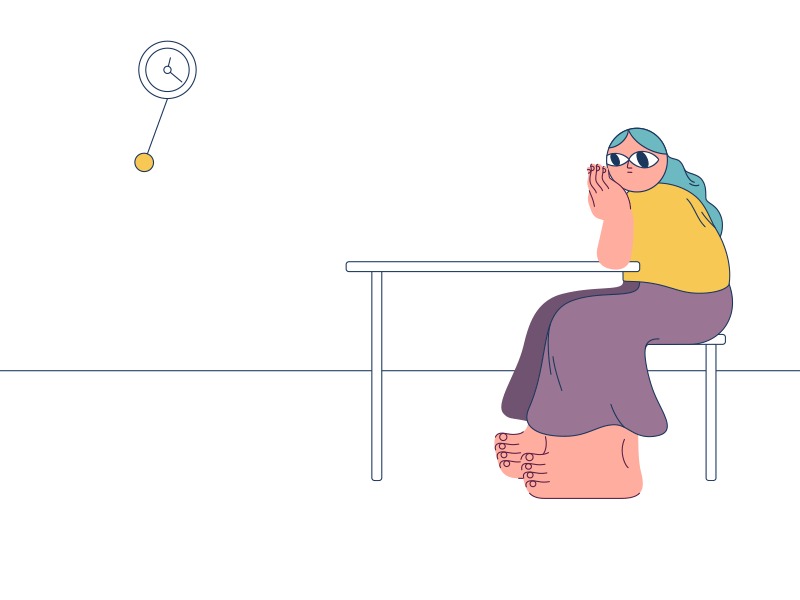
Boredom Is a Signal, Not a Personality Trait
Boredom is often dismissed as trivial, but psychologically, it is much more precise.
Research suggests that boredom appears when you want to engage in something meaningful but cannot. It reflects a breakdown between attention, emotion, and purpose.
That’s why you can be busy and still feel bored. Or surrounded by stimulation and still feel disconnected.
It is not the absence of activity. It is the absence of engagement.
The Quiet Link Between Boredom and Anxiety
Boredom and anxiety are not opposites. They often exist together.
When your mind is anxious, it struggles to settle. Focus becomes unstable. You start something, but your attention slips. You try again, but your mind drifts.
Over time, this creates a loop.
- You cannot engage, so you feel bored
- You feel bored, so your mind searches for stimulation
- Because attention is fragmented, nothing feels satisfying
Studies show that boredom is linked to restlessness, difficulty concentrating, and emotional fatigue, all of which overlap with anxiety patterns.
So what feels like boredom is often
an anxious mind that cannot stay still.
Dopamine and the Need for Constant Stimulation
Dopamine is not just about pleasure. It is about motivation, reward, and staying engaged.
In a slower environment, dopamine helps you build interest gradually. But in a high-stimulation environment, your brain gets used to quick rewards.
Short videos, constant scrolling, instant replies. These create repeated dopamine spikes.
Over time, your baseline shifts.
Now, anything that is slower, quieter, or requires effort feels less rewarding. Not because it is boring, but because your brain expects more stimulation to stay engaged.
This is where people start experiencing what is often described as a
dopamine imbalance, where motivation drops even when opportunities are present.
Why You Feel Restless Even When You Are Doing Nothing
One of the most confusing parts of this experience is that rest does not feel restful.
You sit down, but your mind keeps moving. You try to relax, but you reach for your phone. You pause, but the pause feels uncomfortable.
This is because boredom itself can activate low-level stress.
Research shows that boredom can bring a mix of tension, irritability, and mental fatigue, making it harder to stay present or feel calm.
So instead of resting, your mind keeps searching for something to hold onto.
The Emotional Layer Beneath Boredom
Not all boredom is about stimulation.
Some of it is about disconnection.
When you feel detached from what you are doing, or uncertain about direction, or emotionally checked out, even meaningful activities can feel empty.
Psychological research highlights that boredom often reflects a disconnect from your internal state, your values, and what actually feels meaningful to you.
So the question shifts.
It is no longer “Why am I bored?”
It becomes “Why does nothing feel meaningful enough to stay with?”
When Boredom Becomes a Pattern
If this state continues, it starts showing up in subtle ways.
- You lose focus more easily
- You delay tasks
- You feel mentally tired without doing much
- You rely on quick distractions to get through the day
Over time, this can affect motivation, mood, and increase reliance on unhealthy coping patterns like excessive screen time or avoidance.
This is usually when people begin exploring therapy or online therapy, not for boredom itself, but for what sits underneath it.
Shifting the Pattern
The goal is not to eliminate boredom. It is to understand it.
Sometimes that means reducing constant stimulation. Sometimes it means rebuilding attention slowly. And sometimes it means sitting with the discomfort instead of immediately escaping it.
Because boredom, uncomfortable as it is, often carries information.
It tells you when your attention is scattered. When your mind is anxious. When your life feels misaligned.
And when you stop immediately filling it, you begin to hear it.
When to Seek Support
If you feel constantly disengaged, restless, or unable to focus, it may not be something you fix with discipline alone.
Working with a therapist can help you understand whether this is driven by anxiety, attention patterns, emotional disconnection, or a combination of all three.
With
online therapy, this process becomes easier to access and sustain.
Conclusion
Boredom today is not empty.
It is layered. With anxiety, overstimulation, and a quiet loss of connection to what feels meaningful.
Once you start seeing it as a signal instead of a flaw, it changes how you respond to it.
Not with more distraction. But with more awareness.
Mansi Blog - Why Are You Always Bored?